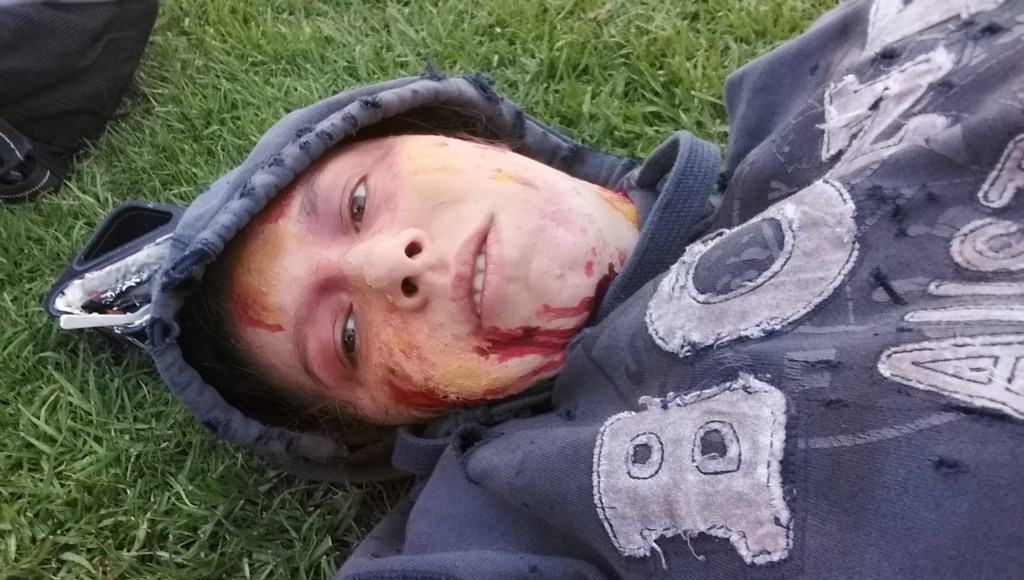
Sometimes you’ll have plans for dark scenes in a tabletop game or a LARP that really evoke horror or despair and it’s important to check in with your players first to be sure they are okay with that. Unfortunately, if you don’t give enough examples of what you mean they might, as happened to me, say “oh, anything and everything,” thinking only of their character being tortured, seeing torture, seeing gore FX or encountering jump scares and knowing that themes of sexual assault were banned in the game.
They hadn’t thought of the scenario I was planning, though. Thankfully as I mulled over the scene, I thought that the scene was unexpected enough that it was worth getting explicit consent on. The scene involved them being forced at gunpoint by evil scientists to commit cruel science against a beloved NPC that I was portraying. It was LARP, too, so they would get to physically get to play it out (though obviously without actually causing any harm – it was all pretend).
Now it’s easier to roleplay being tortured, because you’re not experiencing any pain, and can be reassured of your own safety. But *seeing* someone being tortured and watching them react? That can often be harder as you’re not getting the this-doesn’t-hurt safety signals!
So I checked with another player who wasn’t involved, and he agreed that the players likely hadn’t thought of that scenario, so I decided to do something different and less disturbing for the scene and later asked the players if they would have been okay with the scene I had initially planned.
Uniformly, those who had the attachment to the NPC, were not. We had safety gestures that would have allowed them to leave the scene and three out of four of the players agreed they would have used them. (I had also instituted a fainting mechanic as an extra in-game justification for folks leaving to help those who might be shy about “disrupting the scene,” even though they had every right to).
It wasn’t the gore they objected to, I should add, but the experience of having to be intimately involved in the torture of an NPC they cared about and then having to deal with the emotional consequences for both their characters and the NPC afterwards.
So, in both LARP or tabletop, be explicit when seeking consent. You can sometimes, with player agreement, obscure just what the scene is by providing a list of examples that includes what you are talking about but you should also anchor the discussion by reminding them that they should think not only about the scene itself but about whether they would enjoy roleplaying the emotional consequences of that scene.
Also if you get agreement from a small portion of your player base (whether 2 out of 4 of your tabletop group or 4 out of 16 of your LARP group) you should also consider what impacts that private scene will have on the others who then have to roleplay with the consequences of that scene. Roleplaying the friend of a character who has experienced torture can sometimes be even harder than roleplaying the torture victim because, again, you don’t have all the internal cues of personal comfort and lack of pain to counter the pretend.
So a dark scene should ideally be agreed upon by *all* players, even those not directly involved, they should all think about not on the scene itself but the emotional consequences, and they should have shared expectations about the sort of thing the scene might include. When in doubt, simply providing the full description of the scene can be helpful. At the very least, have it as an option for those who’d prefer it. There should also be an opt-out mechanic people can quickly and easily use mid-scene to leave and the understanding that the scene itself can be broken if need be. After all, in this instance the affected player might need to break the illusion completely in order to be comforted. And that needs to be okay.
 Adelaide Roleplaying Community Inc.
Leave a comment